Abstract Reasoning
Master the key skills for EPSO ad exams with clear examples and smart strategies.
Abstract Reasoning
Master the EPSO test with clear examples and smart strategies.


Abstract Reasoning : An Introduction
What is abstract reasoning?
Abstract Reasoning is the ability to decode the "logic of patterns" by stripping away noise to find the core rule(s). Instead of asking "what" a series of objects is, it asks "how" it behaves. It is the purest form of Fluid Intelligence: identifying hidden structures, predicting shifts, and solving complex problems without prior knowledge. In essence, it is the mental skill of finding order within chaos.
Key data and test guidelines
In an EPSO abstract reasoning test, you are looking for logical operators applied to a vignette (a sequence of five frames). Candidates will have to answer 10 questions within 10 minutes, resulting in an average time of one minute per question.
The question prompt reads: From the options available, please choose which diagram would come next in the series above.
Currently, candidates are expected to receive a combined pass score of 10/20 in the numerical and abstract reasoning tests. Imminent clarifications by EPSO may change elements of the NoC.
What types of transformations appear in the EPSO test?
The most common transformation types found in the modern EPSO exam are:
A. Movement & Position
Linear Translation: Shapes move across a grid or along an axis (e.g., one step to the right or left each frame).
Circular/Orbital: Moving around a center point or along the perimeter of the frame (clockwise or counter-clockwise).
Jump Progressions: Movement that isn't constant (e.g., +1, then +2, then +3 steps).
B. Orientation & Rotation
Constant Rotation: Rotating by a fixed angle (usually 45°, 90°, or 180°).
Mirroring/Reflection: The shape flips across a vertical, horizontal, or diagonal axis.
Pointing Logic: Arrows or triangles that point toward a specific "trigger" shape or a changing corner.
C. Quantitative Changes (Numerical Logic)
Addition/Subtraction: The number of elements increases or decreases by a fixed amount.
Side Counting: The logic is tied to the number of sides (e.g., a triangle [3] is replaced by a square [4], then a pentagon [5]).
Summation Rules: The total number of a specific feature (like "black dots") in Frame 1 and Frame 2 equals the total in Frame 3
D. Attribute Transformations
Color/Shading Shifts: A shape cycles through different fills (e.g., White → Grey → Black → White).
Size Variation: Elements grow or shrink in a predictable sequence.
Conditional Rules (Dependencies): "If shape X is present, then shape Y must be shaded." This is a high-difficulty trigger often used to separate top-tier candidates.
E. Overlapping & Intersection
Superimposition: Two shapes merge; the rule might dictate that the overlapping area disappears or changes color.
Hidden Layers: One shape moves "behind" another and becomes invisible until it emerges on the other side.
How to Prepare Effectively
Preparation for the EPSO abstract reasoning competition is not about "studying" in the traditional sense; it is about neurological conditioning.
Success requires moving from slow, conscious calculation to rapid, subconscious pattern recognition.
Your first step should be to build a typology of key transformations and study the frequency with which they appear in standardized tests.
Given the limited time, prioritizing the most common "logical operators"—such as linear movement and simple rotations—allows you to secure the "low-hanging fruit" questions instantly.
Start by mastering the underlying logic of each transformation type before ever touching a stopwatch. Once the "alphabet" of abstract reasoning becomes clear, pivot to high-intensity simulations to build the mental stamina required for the actual exam day.
To truly bridge the gap between theory and success, the EPSO Unlocked methodology is indispensable. It provides a strategic framework that simplifies complex grids into manageable variables, saving you precious seconds.
Master the "Science of Patterns" with EPSO Unlocked
Success in the EPSO Abstract Reasoning test isn't about guessing; it’s about systematic decoding. While most candidates lose precious seconds overwhelmed by visual 'noise', EPSO Unlocked provides you with a definitive Typology of Transformations -a hierarchical breakdown of the most to least common patterns used by examiners.
Our preparation package moves beyond theory, offering a high-impact practical toolkit designed for the modern exam:
20 Scaled Examples: Step-by-step walkthroughs that transition from foundational logic to high-complexity scenarios.
60 Original, Exam-Level Questions: Rigorous practice sets that mirror the exact difficulty and "traps" of the current EPSO selection process.
Comprehensive Analytical Explanations: We don't just show you the right answer; we teach you the methodology to find it, ensuring you can replicate success under the 60-second-per-question pressure.
Strategic "Day-Of" Blueprints: Specialized tactics to tackle prompt-frame issues and bypass mental blocks when the clock is ticking.
Don't leave your career to chance. Calibration is the key to speed, and speed is the key to the EPSO Reserve List. Start mastering the logic that others miss.
What’s the best strategy for answering quickly?
To beat the test clock, stop "looking" at the whole vignette and start "scanning" specific variables. The suggested most effective methodology is the S.P.A.S. (Scan, Pick, Apply, Select) strategy:
The S.P.A.S. Methodology
1. Scan (The Global View) Spend exactly <10 seconds looking at the whole sequence. Don't look for the answer yet; look for the "actors." Identify what is changing: Is it the number of dots? The rotation of the arrow? The colours or shading of the background?
2. Pick (Single Element Isolation) This is the most critical step. Ignore 90% of the vignette. Pick one single element (e.g., just the black dot), track it across the five frames, and ask yourself: "What exactly is this specific item doing?"
3. Apply (The Rule Extraction) Once you find the rule for that one element (e.g., "it moves clockwise +1 step"), immediately apply it to the options.
The Rule of Elimination: Discard every answer option that doesn't follow this specific rule. Usually, this removes 2 or 3 wrong choices instantly.
4. Select (The Final Filter) If more than one option remains, pick a second element (e.g., the shading) and track its logic. Compare the remaining options only against this second rule. This will almost always leave you with the unique correct answer. Focus on spotting key changes first, skip tough questions, and return if time allows.
5.The "Reverse" Check: If the pattern in the reference frames remains invisible, scan the 5 answer options. Often, the correct logic reveals itself through common traits shared by the majority of the options, helping you "reverse-engineer" the rule.

Master the complexities of logic with this curated sequence of 10 advanced abstract reasoning challenges. Presented in a streamlined flashcard format, this set is designed to push your cognitive boundaries. Challenge yourself to achieve mastery within a 10-minute window.
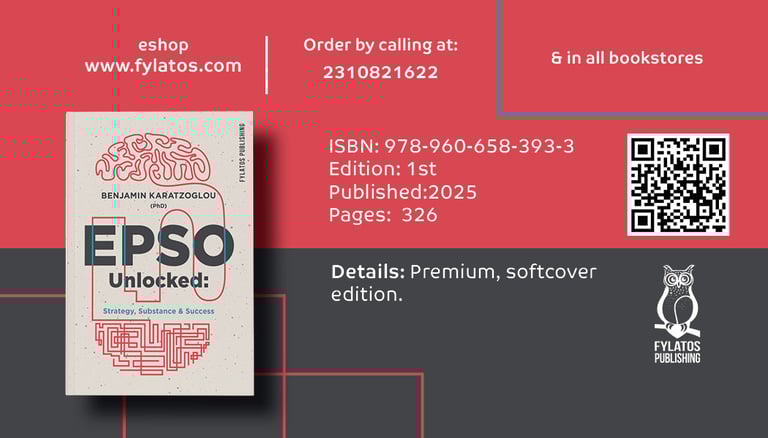
Elevate your preparation further with dozens of original, high-level questions found exclusively in our book: EPSO Unlocked: Strategy, Substance & Success.
Επικοινωνία Θεσσαλονίκη
info@postgradsuccess.org
For general enquiries, observations, requests, or comments, feel free to get in touch.
We respond promptly, clearly and efficiently, normally within 48 hours.
0030-6972556867
0030-2313076263