EU Knowledge and Digital Skills
Your guide to mastering EU knowledge and digital skills for the AD exam
The official presentation of the EU Knowledge test
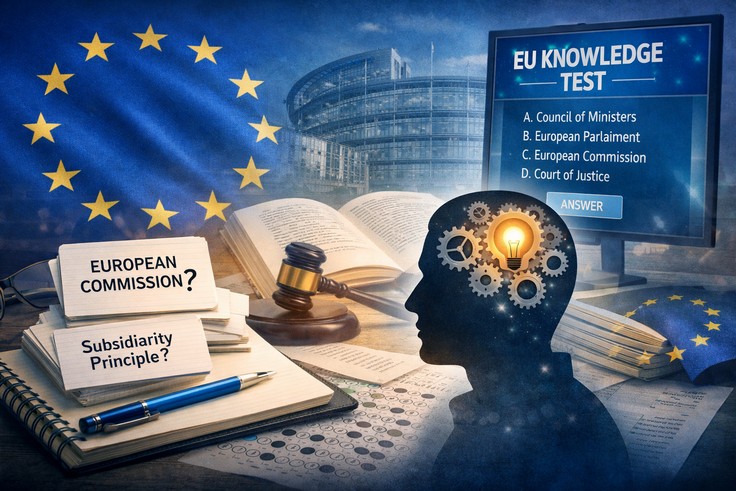
The EU knowledge test consists of a multiple-choice questionnaire covering the European Union, its institutions, procedures, and main policies. References to the sources used to develop this test will be made available on the EPSO website after the notice of competition is published.
In the meantime, you can find a selection of publications here to help you prepare for the EU Knowledge test.
You can also try official sample tests here.
Our perception of the EU knowledge test and the optimal way to prepare for it
EPSO EU Knowledge: Beyond Memorisation
A Structured Guide to the Test and Smart Preparation
At first glance, the EPSO EU Knowledge test appears to reward memory: Treaties, institutions, competences, procedures. Candidates often wonder whether success depends on recalling which treaty article says what. That, however, is only surface. And surfaces rarely win European competitions.
EU Knowledge is not a trivia test. It is a test of institutional intelligence.
Memorisation in the Age of AI
In an era where Artificial Intelligence provides instant access to information, mechanical memorisation may seem outdated. Yet, even the most advanced tools operate on what you already understand. If you do not grasp that the Commission proposes while Parliament and Council decide, you cannot frame the right question (a.i. prompt) nor assess the quality of the answer.
Internalised knowledge creates a “mental map.” You do not need to memorise every detail, but you must understand the structure. Information already embedded in your mind activates critical thinking far faster than external searches. It becomes the operating system on which every analytical tool runs.
What the Test Really Assesses
The EU Knowledge test evaluates two core abilities:
1. Institutional literacy.
Understanding who decides what, the legal basis of an act, the distinction between a Regulation and a Directive, or when subsidiarity applies. Recognition of terminology is not enough; functional comprehension is required.
2. Cognitive endurance and precision.
Questions demand sustained attention to dense, technical wording. A single term can alter the meaning of an entire provision. The test rewards careful, composed reasoning — not reflex answers.
The E.U. is a legal-political hybrid, a permanent mechanism of compromise. Without understanding institutional balances, the role of the Court of Justice, or the limits of competence, you create institutional risk. In practice, that means policies vulnerable to legal challenge or political blockage.
At a basic level, the test does check memorization. At a higher level though, it measures structural reasoning and the ability to connect policies. Successful candidates do not simply know who established what and when; they understand why, and what equilibrium that creation serves.
Why Flashcards and Drills Are Not “Simplistic Tools”
Flashcards are often dismissed as routine-learning devices. Used properly, they are anything but.
Active recall forces the brain to retrieve information without prompts, strengthening neural pathways more effectively than passive reading. Spaced repetition stabilises knowledge over time. Together, they transform scattered information into structured understanding.
Targeted drills go further:
They expose conceptual gaps.
They train candidates to decode question logic.
They sharpen the distinction between similar -but legally distinct- answer choices.
They build speed without sacrificing accuracy.
Well-designed practice sets, such as those to be available on postgradsuccess.org, are not about memorising definitions. They are designed to build institutional reflexes. With repeated exposure, candidates begin to recognise patterns: when an option breaches a principle, when a competence is overstated, when a formulation is too broad to be legally sound.
In other words, flashcards and drills do not teach you to “remember more.” They train you to think within the system.
A Smarter Preparation Strategy
Effective preparation rests on four pillars:
Move from “who” and “what” to “why” and “how”.
Practise systematic active recall.
Connect institutional knowledge to political reality.
Analyse every answer choice critically.
When combined, these elements turn knowledge from fragmented information into operational competence.
Conclusion
In the European public sphere, those who thrive are not those who memorise the most detail, but those who understand the system’s logic. Details evolve; institutional balances endure.
The EU Knowledge test does not ultimately examine memory. It examines whether you can operate with institutional awareness.
And that capacity is not developed through passive reading, but through deliberate, structured, and intellectually demanding practice.
EPSO AD5 Digital Skills Test: Overview


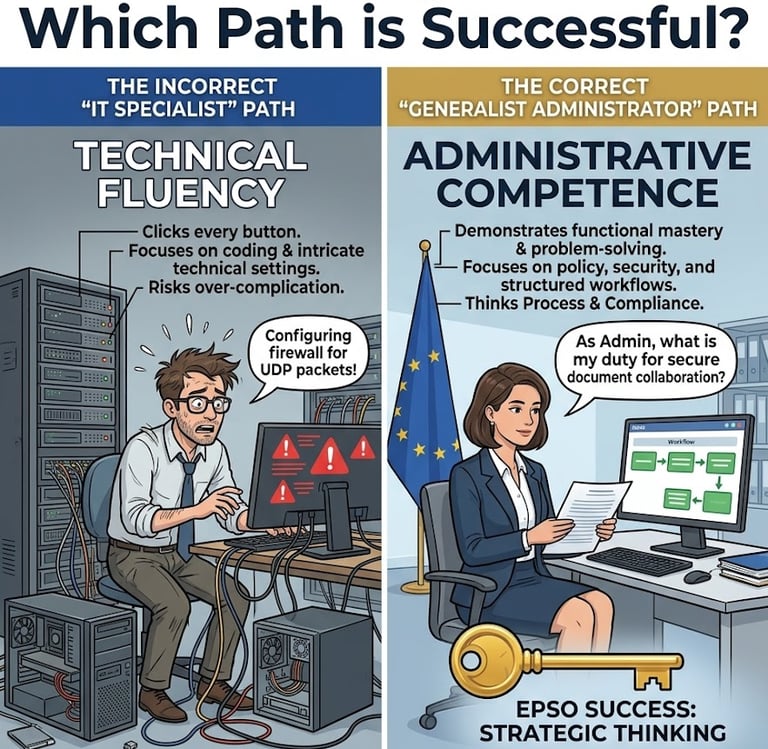
The EPSO AD5 Digital Skills Test evaluates practical IT proficiency for everyday administrative work through multiple-choice questions. It targets generalist administrators rather than IT specialists, focusing on functional, workplace-ready digital skills rather than coding or advanced technical expertise.
Test Format
Question type Multiple-choice (MCQs)
Target level Generalist AD5 administrators -2026 examination
Focus Daily office IT skills and secure, collaborative digital work
Our Perception of EPSO Digital Skills: Think like an Administrator, not an IT Expert
A Structured Guide to the Test and Smart Preparation
At first glance, the EPSO Digital Skills test seems to measure technical competence: software use, online collaboration, cybersecurity awareness. Candidates often wonder whether success depends on knowing every shortcut in Excel or every function in Teams. That, however, is only surface. And surfaces rarely win European competitions.
Digital skills for administrators are not about IT wizardry. They are about operational intelligence in a digital environment.
Practical Fluency in the Age of Digital Work
Modern public administration demands more than knowing how to operate tools; it requires understanding when, why, and how to deploy them. Advanced systems or technical knowledge are irrelevant if the administrator cannot structure data, communicate securely, manage complcated or crisis situations, or leverage digital workflows to achieve policy goals. Digital fluency becomes a form of institutional competence: knowing not just what a tool does, but how it serves administrative objectives.
What the Test Really Assesses
The EPSO Digital Skills test evaluates three core abilities:
Operational digital literacy.
Beyond clicking buttons, this means understanding workflow efficiency, document management, collaboration tools, and digital security principles. Candidates must demonstrate functional mastery, not technical virtuosity.Analytical and problem-solving aptitude.
Questions often embed small operational dilemmas: which tool or method ensures compliance, timeliness, or clarity? Candidates must interpret scenarios, weigh options, and anticipate consequences.Cognitive endurance and precision.
Digital questions are often embedded in dense, procedural contexts. A single misinterpretation can lead to an incorrect assessment of the scenario. The test rewards careful reasoning and structured decision-making, not reflexive button-pushing.
Why Flashcards, Drills, and Simulation Tests Matter in your Preparation
Digital proficiency is gradually built, not memorised. To that end, flashcards and drills are not supplementary - they cultivate reflexive understanding:
Flashcards reinforce core concepts (data security rules, workflow principles) through active recall.
Targeted drills expose operational gaps and train the mind to decode scenario logic.
Structured simulations replicate real-world administrative tasks, allowing repeated exposure to decision-making under time constraints.
Together, these tools transform scattered technical knowledge into operational fluency, creating administrators who can navigate the digital environment with confidence and accuracy.
A Smarter Preparation Strategy
Effective preparation rests on four pillars:
Move from “how” to “why” and “when” – understanding purpose and context, not just mechanics.
Practise systematic active recall of core digital principles.
Connect tool use to operational objectives and legal or procedural requirements.
Analyse every scenario critically, noting implications of each choice.
When combined, these elements turn digital literacy from fragmented technical ability into operational competence.
Conclusion
In European public administration, those who excel are not the most technically savvy, but those who can leverage digital tools strategically and accurately. The EPSO Digital Skills test does not simply evaluate whether you can use software—it measures whether you can operate efficiently, securely, and thoughtfully in a digital workspace. That capacity is developed not through passive reading, but through deliberate, structured, and intellectually demanding practice.
Five Core Competencies
Information & Data Literacy: Finding, storing, evaluating, and organizing digital information
Communication & Collaboration: Using digital tools for interaction, sharing, and teamwork (email, online platforms)
Digital Content Creation: Creating and editing content (text, images); understanding copyright; using basic software (word processing, spreadsheets)
Safety: Identifying risks; protecting devices, data, and privacy; recognizing threats (firewalls, phishing, password security)
Situational Judgement and Problem Solving:Troubleshooting technical issues; identifying needs for new tools; using technology creatively and efficiently
Key Points for Candidates
Practical focus: Everyday scenarios (e.g., identifying a browser, understanding firewalls)
Literally not tested: Coding, advanced technical architecture, or specialist IT knowledge
Priority: Secure, effective, and collaborative use of standard digital tools
Pro-Tips for the EPSO Digital Skills Test
The "Safety-First" Mindset: When in doubt, always pick the answer that prioritizes data protection, security, and accountability. EPSO values cautious civil servants.
DigComp 2.2 is your Bible: Familiarize yourself with the 5 areas. If a question asks about a colleague making a mistake, the answer is usually constructive collaboration (restoring versions) rather than punishment.
Keywords for Success:
Data Minimisation: Only collect what is needed.
Privacy by Design: Security must be built in from the start.
Interoperability: Using open formats like CSV/JSON.
Critical Evaluation: Don't trust AI outputs blindly; always validate.
Pro-Tips και η στρατηγική
διαφοροποίησης της
διοικητικής από την
τεχνική ανταπόκριση
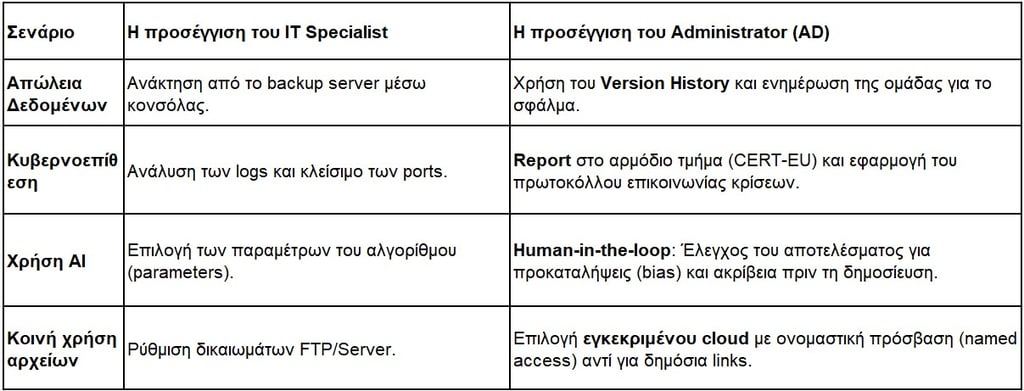
1. Η Στρατηγική του "Policy vs. Technicality"
Όταν διαβάζεις μια ερώτηση, αναρωτήσου: «Αυτό αφορά τη διαδικασία (process) ή το εργαλείο (tool)?»
Λάθος (Technical): Πώς ρυθμίζεται το firewall προκειμένου να επιτρέπει πακέτα UDP;
Σωστό (Administrative): Ποια είναι η ευθύνη μου ως Administrator αν ένας εξωτερικός συνεργάτης ζητήσει πρόσβαση σε αρχεία πίσω από το firewall;
2. Βασικοί Όροι "Κλειδιά" για Administrators
Στο τεστ θα συναντήσεις όρους που ακούγονται τεχνικοί, αλλά η σημασία τους είναι διοικητική:
Interoperability (Διαλειτουργικότητα): Για έναν υπάλληλο AD5-AD7, ο όρος σημαίνει ότι τα δεδομένα πρέπει να είναι σε μορφή που να μπορούν να διαβαστούν από άλλα τμήματα ή κράτη μέλη (π.χ. JSON/XML αντί για κλειδωμένα PDF).
Data Minimisation (Ελαχιστοποίηση): Η διοικητική πρακτική του να ζητάς μόνο τα απολύτως απαραίτητα δεδομένα για μια αίτηση. Αν μια ερώτηση προτείνει "συλλογή περισσότερων δεδομένων για μελλοντική χρήση", είναι σχεδόν πάντα λάθος.
Privacy by Design: Η υποχρέωση του στελέχους να σκέφτεται την προστασία δεδομένων, ήδη από το στάδιο του σχεδιασμού μιας νέας πολιτικής ή φόρμας, όχι εκ των υστέρων.
3. Διοικητικές Πρακτικές vs. IT Λύσεις
4. Το Πλαίσιο DigComp 2.2 (Ο "Χάρτης" σου)
Το EPSO βασίζεται σε αυτό το πλαίσιο. Εστίασε στις εξής 3 περιοχές που "καίνε" τους AD:
Safety (Ασφάλεια): Όχι μόνο από ιούς, αλλά και προστασία της ψηφιακής ταυτότητας του θεσμικού οργάνου.
Problem Solving: Εδώ το τεστ ζητά να δείξεις ότι μπορείς να βρεις λύση σε ένα ψηφιακό πρόβλημα (π.χ. ασυμβατότητα αρχείων) χρησιμοποιώντας τα διαθέσιμα εργαλεία, χωρίς να περιμένεις πάντα τη βοήθεια του IT.
Digital Literacy: Η ικανότητα να ξεχωρίζεις τις "ψευδείς ειδήσεις" (misinformation) και να χρησιμοποιείς αξιόπιστες πηγές για τα briefings σου.
5. Η "Χρυσή Συμβουλή" για τα SJ (Situational Judgement) Digital Questions
Στις ερωτήσεις κρίσης (Situational Judgement), η ΕΕ αναζητά πάντα το στέλεχος που:
Δεν παίρνει ατομικά ρίσκα με την ασφάλεια (πχ., εγκαθιστώντας δικό του ή τροποποιώντας υπάρχον λογισμικό).
Προωθεί τη συνεργασία (χρησιμοποιεί συμμετοχικά εργαλεία (open formats όπως CSV/JSON)).
Δείχνει ενσυναίσθηση (φροντίζει για την προσβασιμότητα των εγγράφων από ΑμεΑ).
Λογοδοτεί (κρατάει ίχνη/logs των αποφάσεων).
Φροντίζει για την ασφάλεια των δεδομένων που διαχειρίζεται ήδη από τη φάση σχεδιασμού ενός προγράμματος.
Αξιολογεί κριτικά κάθε απόφαση επικυρώνοντας τις εισηγήσεις άλλων και κυρίως αυτές της Τ.Ν.
Συμπέρασμα: Αν μια απάντηση σας φαίνεται υπερβολικά "τεχνική" (π.χ. περιλαμβάνει εντολές τερματικού ή συγκεκριμένες ρυθμίσεις hardware), πιθανότατα είναι ο "περισπασμός". Η σωστή απάντηση θα αφορά πάντα τη διαδικασία, τη νομιμότητα και την ομαδική αποτελεσματικότητα.
Και τώρα επισκεφτείτε το Portal των ερωτήσεων για να ελέγξετε τον βαθμό εμπέδωσης των παραπάνω αρχών και υποδείξεων.
Σημείωση: Μέσα στο portal θα βρείτε στοχευμένες ερωτήσεις, σχεδιασμένες ακριβώς πάνω στο πλαίσιο DigComp 2.2 και τη θεσμική λογική που αναλύθηκε παραπάνω —σενάρια που δεν πρόκειται να συναντήσετε στις περισσότερες κοινές βάσεις θεμάτων πληροφορικής (IT test banks).
And now visit our Question Portal to check how well you have internalized the above principles and guidelines.
Ready for the Next Level?
The Question Portal area is reserved for those working with EPSO Unlocked.
Note: Inside the portal, you will find targeted questions modeled directly after the DigComp 2.2 framework and institutional logic analyzed above -scenarios that you will not find in most generic IT test banks.
To enter, you’ll need to provide a specific keyword from the book — your gateway to these advanced exercises.
In the near future, additional Flashcard packs and drill tests will be released regularly, expanding this members-only training area and giving you continuous, structured practice.
Start Practicing for AD5 Today – Order 'EPSO Unlocked' and gain access to 400+ Practice Questions
Επικοινωνία Θεσσαλονίκη
info@postgradsuccess.org
For general enquiries, observations, requests, or comments, feel free to get in touch.
We respond promptly, clearly and efficiently, normally within 48 hours.
0030-6972556867
0030-2313076263